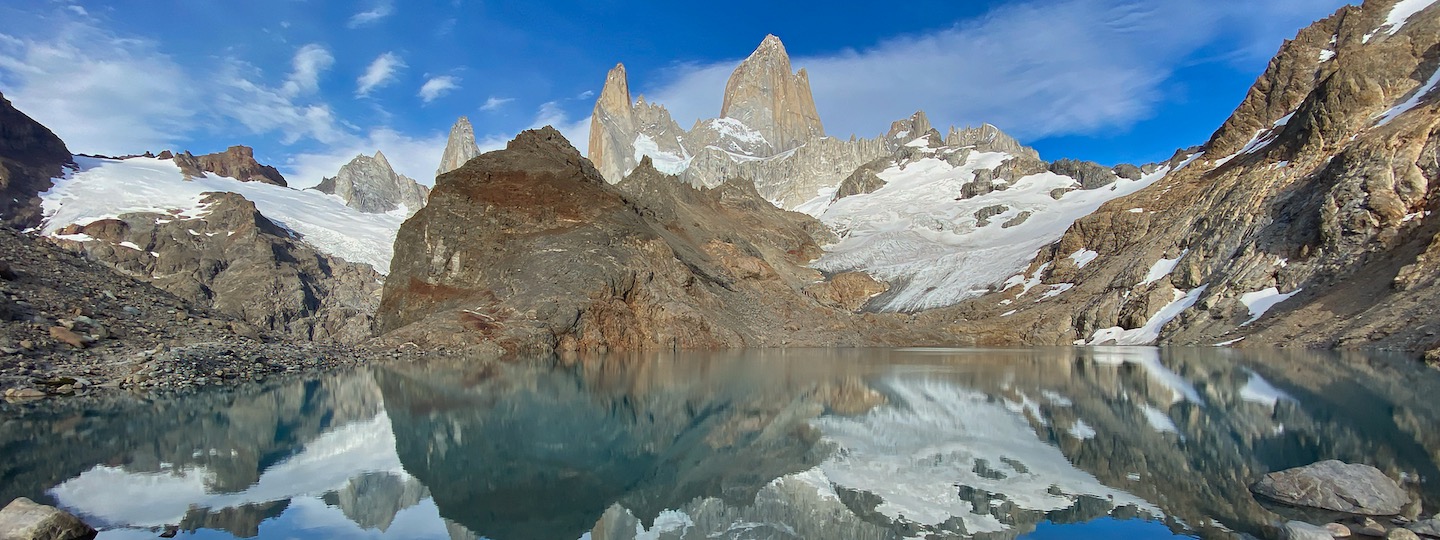
Laguna De los Tres
Self-guided trek to the foot of Fitz Roy
Hike to the natural viewpoint closest to the walls of Fitz Roy and its granite needles!
Laguna De los Tres is the most popular hike in El Chaltén: a self-guided trail in Los Glaciares National Park, about 25 km (15.5 mi) round trip and 8 to 9 hours long, that ends at the glacial lagoon at the foot of Mount Fitz Roy. It starts at Portal Base Fitz Roy, at the end of Avenida San Martín, and can be done all year round, although the best time is from October to April. It is moderate to hard: the first 10 km are moderate and the last 2 km are demanding. There is an entry fee to the park, and the pass is bought online.
The trail climbs the Arroyo del Salto valley through ñire and lenga forests, with viewpoints over the Río de las Vueltas valley and the Fitz Roy massif, passes Poincenot campsite and ends with a steep climb to the old moraine that holds the lagoon. You can also get there from Portal Río Eléctrico, on Provincial Route 41, along a trail that joins the main one just before Poincenot campsite.
- Foreign visitors (general): AR$ 50,000
- Argentine residents: AR$ 25,000
- Santa Cruz residents: AR$ 8,000
- Students (Argentine): AR$ 15,000
- Children under 6, retirees/pensioners, residents of El Calafate, El Chaltén or Tres Lagos, people with disabilities/companion and Malvinas veterans: Free
Source: National Parks
Trail map
The solid blue line shows the trail from Portal Base Fitz Roy, in El Chaltén, to Laguna De los Tres; the dotted blue lines, the Laguna Capri variant and the alternative trail from Portal Río Eléctrico, which joins the main one next to Poincenot campsite; and the gray line, the road along Provincial Route 41 from El Chaltén to the Río Eléctrico bridge.
Trail map
Itinerary
It is about 12.5 km (7.8 mi) each way, with 800 to 900 m (2,600 to 2,950 ft) of elevation gain between town and the lagoon. The way up takes 4.5 to 5 hours and the way back, along the same trail, a little less. If you set off early, at first light, you have plenty of time to enjoy the lagoon and get back before dark.


Portal Base Fitz Roy
The trail starts at Portal Base Fitz Roy, at the end of Avenida San Martín, where the town ends, next to the parking area by the old "Puesto Amarillo". During the first hour the slope is fairly steep and leads to a natural viewpoint over the Río de las Vueltas valley.
The Fitz Roy viewpoint
A few minutes later the trail enters the Arroyo del Salto valley, heading towards Fitz Roy, and the ñire trees become more and more numerous. About an hour and a half from the start you reach a well-signposted rocky viewpoint, with a sign that helps you identify the peaks and glaciers in front of you.
Shortly before the viewpoint, on the left, a variant of similar length branches off past Laguna Capri and its campsite, with views of Fitz Roy, and rejoins the main trail further on. You can take one way up and the other way back.
Poincenot campsite
The path keeps climbing the Arroyo del Salto up to the area that drains the Madre and Hija lagoons. About 3 hours from El Chaltén you reach Poincenot campsite, one of the busiest campsites in the park, where the trail from Portal Río Eléctrico joins in. After crossing the Río Blanco there is the Río Blanco camp, for climbers only.
The last stretch
From the Río Blanco the hardest part begins: a steep climb of about 400 m (1,300 ft) over rocky ground that takes a little over an hour. In autumn and spring there may be snow or mud on this stretch, where it is easy to lose your way: always check the trail conditions before you set off.
Laguna De los Tres
The trail ends on the old moraine, the huge arc-shaped ridge left by the advance and retreat of the glacier that now holds the lagoon. From there you can see the lagoon, the De los Tres glacier and, closer than from anywhere else, the granite wall of Fitz Roy and its needles. If you get there at sunrise, the reward is double: with the first rays of the sun the peaks turn red.
Laguna Sucia
From the moraine, heading down to the left of Laguna De los Tres, you reach a natural viewpoint with another stunning view: from above you can see, in the distance, the desolate Laguna Sucia and its hanging glaciers.
Alternative from Portal Río Eléctrico
This option avoids repeating a large part of the route on the way up and back, shortens the total distance by 3 km and adds the view of the Piedras Blancas glacier. To get from El Chaltén to Portal Río Eléctrico, take a private transfer or taxi.


Portal Río Eléctrico
The route starts at Portal Río Eléctrico, near the Río Eléctrico bridge, about 14 km (8.7 mi) from El Chaltén along Provincial Route 41. There you have to show the same documents as at Portal Base Fitz Roy.
Up the Río Blanco valley
The path soon crosses the Río Blanco and follows it up towards Poincenot campsite, almost entirely inside the forest, which is welcome on windy or very hot days.
The Piedras Blancas glacier viewpoint
In just under two hours you reach the Piedras Blancas glacier viewpoint, where you can see the glacier with its lagoon and lateral moraines, coming down between Cerro Madsen and Cerro Eléctrico.
The Meeting Point
After about 7 km (4.3 mi) up the Río Blanco valley, the trail joins the main one. There is a Meeting Point there, signposted by the National Parks, which serves as a reference on the park's self-guided trails.
The traverse
Many hikers prefer this option because they do it as a traverse: first they drive along the scenic road up the Río de las Vueltas valley, in under two hours they see the Piedras Blancas glacier, then they climb to the lagoon and walk back to town along the main trail. It is about 22 km (13.7 mi) in total.
Tips for your hike
What to bring
- Energy and hydration: a packed lunch, high-calorie snacks and at least 1.5 liters of water per person.
- For the sun: a hat, sunglasses (ideally with a UV filter) and sunscreen.
- For the cold: gloves, a warm hat and a warm jacket.
- For wind or rain: a windproof jacket, ideally waterproof.
- To walk safely: trekking footwear with good grip, ideally boots that cover your ankles.
- To get back safely: a headlamp, not your phone, which drains quickly in the cold and gives little light.
- Ideal backpack: 25 to 30 liters, to comfortably carry your warm layers when you don't need them, your camera and accessories.
Before you set off
- Buy your park entry pass online before you set off.
- From May to September you must register at the National Park Visitor Center before you set off.
- Check the trail conditions at the National Park Visitor Center.
- Start early and plan your return according to the sunset time.
- Always carry a headlamp (not your phone), just in case.
Would you rather go with a guide?
If you don't want to do it on your own, you can hire a guide or tour operator in El Chaltén, or join the Full Day Laguna De los Tres excursion.
Useful links
- How to get to El Chaltén
By plane, bus or car - Accommodation guide
Where to stay in El Chaltén - Regular buses and shuttles
Timetables to and from El Calafate - Private transfers
To get to Portal Río Eléctrico - Gear rental
Trekking poles, boots, warm clothing and more - The weather
What to expect in each season
What hikers say
“We took bus to Rio Electrico and walked from there, then walked back to El Chaten. The hike up to Tres Lagoon was difficult from the base, otherwise not hard. Bring at least one walking stick. It was difficult and rocky. Beautiful and worth every second.”
“Beautiful hike. I’m not an experienced hiker and I made it, however, bear in mind the last kilometre is very very challenging! It’s super steep, it took me 1 hour 40 minutes to do the last km. […] But definitely worth the struggle”
“The ultimate Patagonia experience! The 12km hike to Laguna de los Tres is definitely exhausting, especially the steep final climb, but the reward is unbeatable. Standing right in front of the majestic Fitz Roy peaks is a moment I’ll never forget.”
Frequently asked questions
Updated: November 1, 2026
Yes. The trail is inside Los Glaciares National Park and there is an entry fee. The pass is bought online on the Argentine National Parks sales site (ventaweb.apn.gob.ar). Entry fees: Foreign visitors (general): AR$ 50,000; Argentine residents: AR$ 25,000; Santa Cruz residents: AR$ 8,000; Students (Argentine): AR$ 15,000; Children under 6, retirees and/or pensioners with an Argentine National Identity Document (native or by option) living in Argentina, residents of El Calafate, El Chaltén or Tres Lagos, people with disabilities and their companion, and Malvinas veterans: Free.
You must show a valid ID document or passport at the ticket office when you buy your pass and/or enter the protected area. The details on it determine your visitor category. Both Argentines and foreigners must show a valid Argentine National Identity Document (DNI) or passport.
From El Chaltén it is an 8 to 9 hour round-trip hike, about 25 km (15.5 mi) in total from Portal Base Fitz Roy, with 800 to 900 m (2,600 to 2,950 ft) of elevation gain. Start early and plan to be back before dark.
Moderate to hard. The first 10 km have moderate slopes, but the last 2 km are demanding: a climb of about 400 m (1,300 ft) over rocky ground that takes a little over an hour.
The trail starts at Portal Base Fitz Roy, at the end of Avenida San Martín, on the northern edge of El Chaltén. You can also start at Portal Río Eléctrico, about 14 km (8.7 mi) from town along Provincial Route 41: from there, a trail of about 7 km (4.3 mi) up the Río Blanco valley joins the main trail just before Poincenot campsite.
Yes, the trail is open all year round. The best time is from October to April. Between April and October there may be snow on the last kilometer, and from May to September registration at the Visitor Center is mandatory.
No. It is a self-guided hike on a well-marked trail. If you would rather go with someone, you can hire a licensed guide or join a full-day excursion.
A packed lunch, high-calorie snacks and at least 1.5 liters of water per person; a hat, UV-filter sunglasses and sunscreen; gloves, a warm hat and a warm jacket; a windproof jacket, ideally waterproof; trekking footwear with good grip, and a headlamp (not your phone). A 25 to 30 liter backpack works best. In winter, trekking poles and crampons for ice are mandatory.
At sunrise: with the first rays of the sun, the granite walls of Fitz Roy and its needles turn red and orange. To get there in time you have to set off in the dark, with a headlamp.
It is called Laguna De los Tres ("Lagoon of the Three") after the three main summits of the Fitz Roy massif that dominate the view from the lagoon: on the right, Fitz Roy (or Cerro Chaltén), 3,405 m; in the center, Aguja Poincenot, 3,002 m; and on the left, Aguja Saint-Exupéry, 2,558 m. The name became popular after 1952, when a French expedition made the first ascent of Fitz Roy. Another version says the name honors three Salesian priests who explored the region in the early 20th century: Alberto María de Agostini, Giuseppe María Borgatello and José María Fagnano.
National Parks
See prices
- Foreign visitors (general): AR$ 50,000
- Argentine residents: AR$ 25,000
- Santa Cruz residents: AR$ 8,000
- Students (Argentine): AR$ 15,000
- Children under 6, retirees/pensioners, residents of El Calafate, El Chaltén or Tres Lagos, people with disabilities/companion and Malvinas veterans: Free
Source: National Parks
By plane, bus or car
Where to stay in El Chaltén
Timetables to and from El Calafate
To get to Portal Río Eléctrico
Trekking poles, boots, warm clothing and more
What to expect in each season


